Personal injury

If your child has been hurt because of their school computer, please complete this intake form.  Our staff will review your submission and respond if we may be able to assist you.

Press & Media

For inquiries regarding press and media, please complete this form.

Has your child been harmed by their school-issued laptop or tablet?


Parents assume that Chromebooks and iPads issued by their kids’ schools are safe, but they are not: school computers are often portals to the open internet, where children are being severely distracted, exposed to inappropriate content, cyberbullied, and contacted by adult strangers.

If your child has been hurt because of their school computer, please complete this intake form. Our representatives will review your submission and will contact you if we believe there is a case.

Learn More

Working to protect students, parents, teachers, and schools from the exploitative practices of the EdTech industry

If you have a problem where school meets technology, we’re here to help.

The EdTech Law Center takes on exploitative AI companies

Over half of all students use AI chatbots every day, often on their school computers without their parents ever knowing. AI chatbots available by default on millions of student computers and bots popular among young people have been rated “Unacceptably Dangerous” for users under 18 by independent researchers, and extract some of their most personal information to feed AI companies’ trillion-dollar models.

The EdTech Law Center is working to hold these companies accountable for the harms they inflict on young people. Learn more.

What is EdTech?

What is EdTech?

EdTech companies provide digital technologies to individuals, schools, and school districts that range dramatically in purpose and function. And the industry’s reach is far and growing, which spells trouble for children.

The kinds of harm children suffer by EdTech vary by product type. Click here to view a categorical breakdown of the primary EdTech software and platforms.

EdTech Overview

New Report

Three Lies About EdTech

Uncover the bogus rationale underlying EdTech’s data grab and imagine a better future for all kids.

Download

Resource

School-Issued Computer Dangers and Harms

A summary sheet of the dangers of school computers and the real-life harms to student.

Download

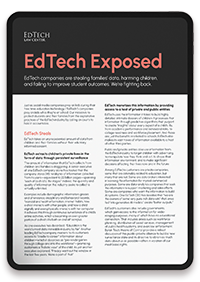
EdTech Exposed

Report

EdTech Exposed

Learn more about how EdTech’s harmful practices and what you can do to protect your family.

Download

Problems for Parents

Problems for Parents

EdTech infringes on parents’ right to parent as they choose. 
The use of digital technologies in the classroom can limit parents’ ability to:

  • Support their kids’ health and wellness
  • Protect their kids from content that does not align with their family’s values
  • Protect their kids from cyberbullying
  • Set and maintain screen-time limits
  • Provide their kids safe and healthy independence
  • Limit commercialization in their kids’ lives
  • Understand the process of their kids’ learning
  • Understand others’ decision-making about their kids
  • Help their kids get into the school or career of their choice
  • Have access to and control over their kids’ information
  • Choose whether to consent to practices that directly affect their kids
  • Safeguard their own privacy and information

Issues with EdTech

Issues With EdTech

  • Invasions of privacy
  • Harms to health and wellness
  • Access to inappropriate content
  • Unhealthy engagement
  • Data insecurity
  • Commercial manipulation
  • Discrimination
  • No access to information
  • No consent

Recent Cases

Active Cases

Filed on: 10.13.2026

Doe v. OpenAI Foundation

On October 13, 2026, the EdTech Law Center joined a coalition of firms in filing a class action lawsuit alleging that OpenAI stole sensitive information from millions of children without valid consent.

View details and key filings »

Updated: 10.05.2026
Filed on: 08.26.2026

Lower Merion School District

On August 26, 2026, seven families from Lower Merion School District outside Philadelphia, PA, sued the District, the Superintendent, and certain members of the board asserting violations of their right under the Fourteenth Amendment to make decisions regarding their children’s health, safety, and privacy, and to direct their education and upbringing.

View details and key filings »

EdTech Law Center in the News

Press Release  |  News

New Class Action Alleges OpenAI Designed ChatGPT to Steal Children’s Personal Information

Read full story »


MCCPTA  |  Parent Resources

Maryland’s Montgomery County Council of PTAs (MCCPTA) survey results on school Chromebook use
Read full story »


Scrolling 2 Death  |  Podcasts

Nicki Reisberg talks to Andy Liddell about her lawsuit against SeeSaw and what parents need to know about kids’ data collection.

Read full story »

Julie & Andrew Liddell

Who We Are

If you have a problem where school meets technology, we can help. The EdTech Law Center (ETLC) works to hold education technology companies legally accountable for the harm they inflict on students, families, and schools.

ETLC’s mission is to keep education free and not conditioned on submission to persistent surveillance and commercial exploitation of student information.

Julie and Andrew Liddell have spent years researching the harms that digital technologies pose to children and advocating for greater protections for children online. They are turning to the courts to help families and schools protect their rights from tech companies that put profits before individuals’ health, safety, and privacy.

Learn more about us »

Parents’ EdTech Bill of Rights

By sending your child to school as is your right and duty, you don’t give up as many rights over your child’s data, health, and safety as tech companies and school administrators would have you believe.

As a parent with a child in K-12 education, some of your rights are the right:

  1. To expect that your children are safe at school offline and online
  2. To receive an education free of persistent and invasive surveillance and exploitation
  3. To expect that school officials have done their due diligence before adopting digital products
  4. To know what digital products your children use at school and to be informed of the risks of harms those products pose to children
  5. To not have the burden of online safety shifted to you or your children
  6. To receive and understand those products’ terms of service, and to decline those terms of service or revoke your consent at any time
  7. To have prompt access to and control over any data collected about your child
  8. To review the school’s contracts with digital-product vendors
  9. To be promptly notified if any student has been harmed through use of a digital product
  10. To voice your concerns about your child’s use of digital products and to be respectfully heard